The adoption of AI agents is reshaping how the internet thinks, acts, and coordinates. Every agent is a node of intelligence – capable of analyzing data, executing tasks, and continually learning from outcomes. However, these agents are working in isolated environments across most Web3 platforms.
This fragmentation reveals a critical fault line in the evolution of decentralized landscape: AI agent interoperability. Without a common framework for communication and coordination, even the most capable agents exist in silos – unable to transfer insight, verify each other’s logic, or work across protocols.
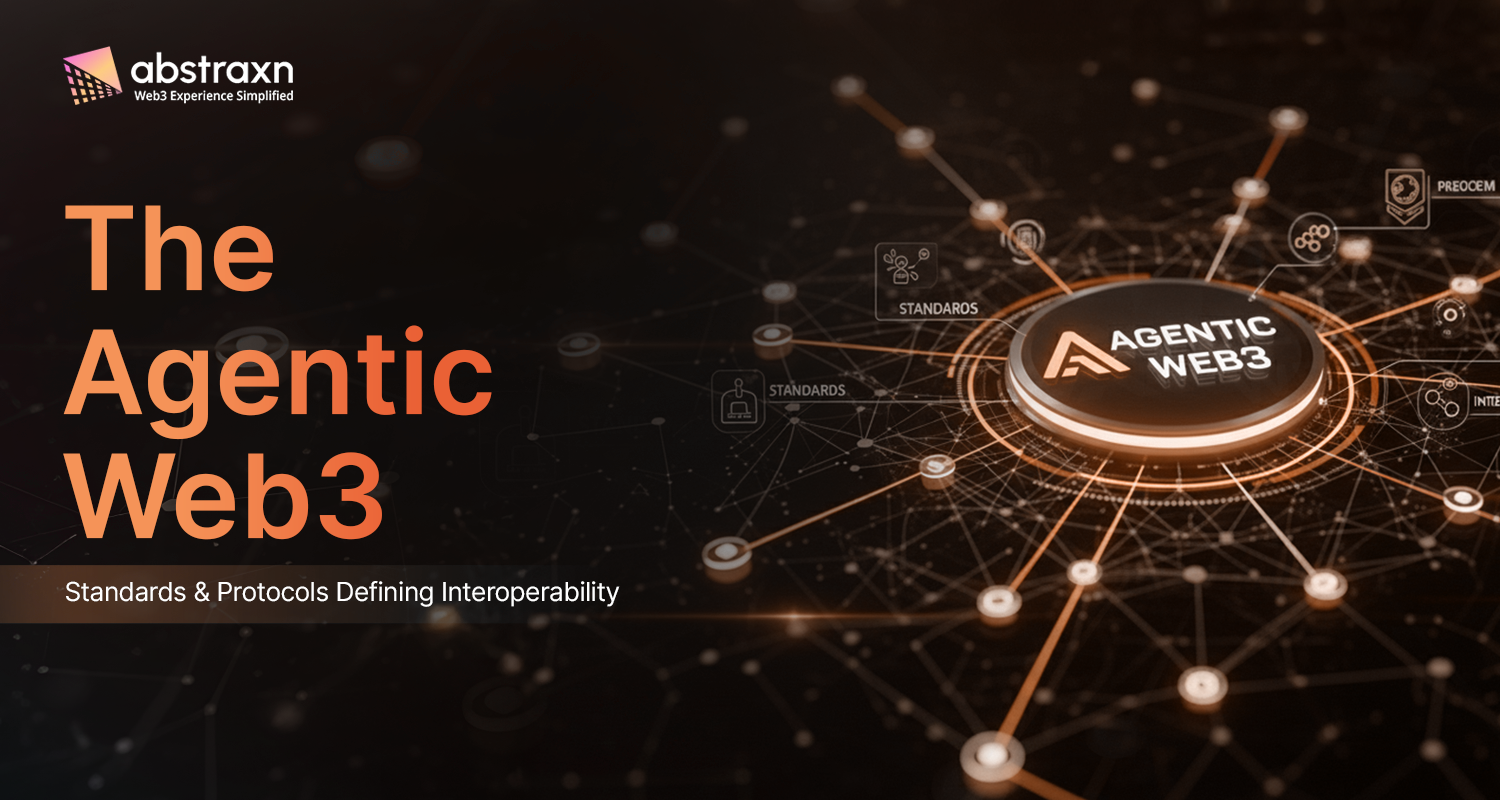
Interoperability standards determine whether the next era of intelligent systems will function as a network or a maze. Each new protocol adds capability, but also complexity. The path forward is the shared standards that let the existing systems communicate easily. Because that’s what the Agentic Web is about: enabling communication between autonomous intelligences for seamless Web3 interactions.
Role of Agentic Protocol Interoperability in Web3
The Agentic Web is determined by how powerfully AI agents connect with each other. And this connection depends on AI agent interoperability – the framework that lets decentralized systems collaborate, communicate, and evolve together.
- From Isolated Intelligence to Collective Cognition
- Decentralized Automation Across Ecosystems
- Establishing Trust Through Transparent Standards
- Foundation for the Cognitive Internet
Currently, most of the Web3 platforms have single-domain AI agents – they manage trades, process data, or automate decisions in isolation. But the next leap in intelligence comes from coordinated effort, where multiple agents share data, verify logic, and synchronize outcomes across environments. This forms the core of AI agent interoperability – transforming autonomy into collaboration.
Web3 thrives on diversity – different protocols, chains, and architectures. But this very diversity often creates friction. Each system has its own way, making cross-protocol collaboration complex and resource-heavy. In this respect, decentralized web standards remove the barriers. By establishing shared frameworks for data exchange, trust verification, and message semantics, they enable cross-platform automation.
When agents communicate through standardized protocols like FIPA or AIIA, they can authenticate intent, validate logic, and exchange outcomes without central oversight. This reduces dependency on intermediaries and allows for verifiable agent-to-agent collaboration. In the Agentic Web, standards don’t just connect systems – they create accountable intelligence.
The long-term impact of interoperability goes beyond DeFi, NFT, or DAO applications. As decentralized intelligence scales, Web3 interoperability standards become the backbone of the cognitive internet. Gartner forecasts that 40% of enterprise applications will incorporate task-specific AI agents by 2026, compared to less than 5% in 2025.
Decentralized Web Standards: Where Data, Identity, and Protocols Align
Three protocol groups are converging to convert isolated AI agents into collaborative networks: the Model Context Protocol, Agent2Agent, and the AGNTCY initiative. Each takes a distinctive approach to AI agent interoperability, and together they are building the foundation, referred to as “Internet of Agents.”
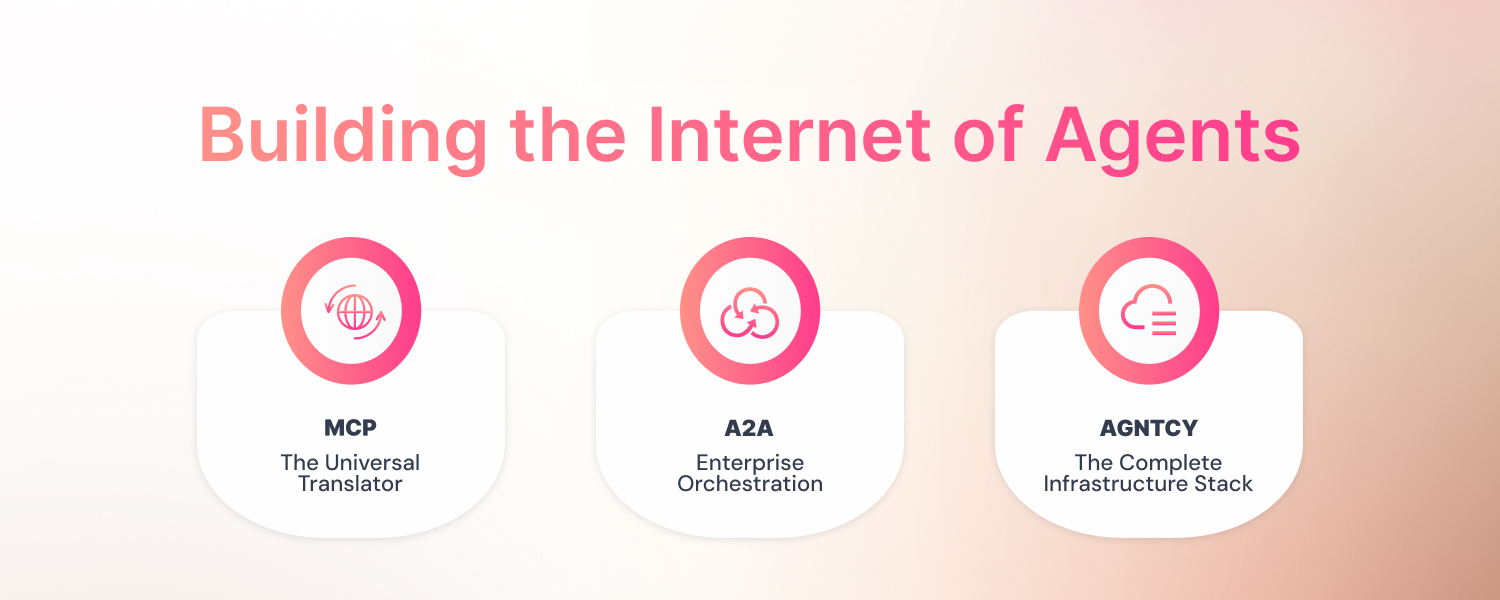
Model Context Protocol (MCP) came from Anthropic as a standardized approach for connecting AI models to external data sources and tools. Apart from being a connection layer, it carries strategic significance. MCP works like a universal translator for agent capabilities, facilitating agents to discover, evaluate, and invoke tools across different ecosystems without any custom integration code.
What began as a single vendor’s approach is gradually transforming into an industry-wide protocol. The strategic strength of MCP is well demonstrated by its ability to let agents share a common language for capability discovery. For instance, a DeFi agent developed by one team can instantly use yield optimization tools created by another, without either team writing any bridge code. In other words, the barriers to composability are eliminated.
Google launched the Agent2Agent protocol in April 2025 with a key thesis: agents require more than tool discovery, they need orchestrated collaboration. While MCP connects agents to capabilities, A2A focuses on helping agents coordinate complex workflows across technical and organizational boundaries. It can be seen as a neutral infrastructure, being built in public.
A2A’s design acknowledges that AI agent interoperability entails resolving trust, security, and attribution challenges that simple tool-sharing cannot address. For example, when a financial services agent has to coordinate with a compliance agent from a different vendor to execute a cross-chain transaction, they need cryptographically verifiable identities, permission frameworks, and audit trails.
In an environment, where trust is distributed and transactions are irreversible, agent collaboration cannot solely rely on implicit assumptions about shared security models.
AGNTCY & The Open Standards Movement
While MCP and A2A emerged from major tech companies, AGNTCY represents a coalition-driven approach to building the complete infrastructure stack for agent collaboration that covers discovery, identity, messaging, and observability. At its core lies the Open Agentic Schema Framework (OASF), a standardized system for stating AI agent capabilities, interactions, and metadata that allows consistent definition and discovery of agent abilities across distributed systems.
By solving critical interoperability challenges like data silos and inconsistent APIs, OASF reduces integration costs by around 40-60%, as compared to custom implementations. The framework also supports describing A2A agents, MCP servers, and can be extended to manage other formats as well, ultimately positioning itself as the meta-layer that enables various protocol families to execute together.
AGNTCY includes cryptographically verifiable identity and access control framework that assures agents can act securely across organizational boundaries, and multi-modal communication support through SLIM (Secure Low-latency Interactive Messaging). These are basically responses to deployment challenges that emerged from early multi-agent systems.
The Path Forward
With Web3 interoperability standards evolving and adoption accelerating, the window exists for platforms to establish competitive positioning that compounds over time. The emergence of standard agentic interoperability protocols creates a strategic decision point: platforms can either implement protocol support as a technical checkbox, or they can architect around protocol-native intelligence from the foundation. Abstraxn takes the second approach.
We have built a network of specialized AI agents that abstracts interoperability concerns completely. At Abstraxn, we view interoperability not as an infrastructural upgrade, but a syntax of intelligence. This ensures our agents aren’t just executing actions, but also evolving through every interaction.
Our architecture takes protocol standardization as the connector that enables something more powerful: intent-driven orchestration across AI interoperability. For instance, our information agent discovers capabilities across protocols. Our transactional agent coordinates execution with MCP tool invocation or A2A multi-agent collaboration. Our WalletOps Agent manages the complexity of cross-chain state management and security verification. In other words, the protocol layer becomes invisible infrastructure, and intelligence becomes the interface.
In essence, protocol interoperability in Web3 doesn’t just streamline processes – it multiplies intelligence throughput across the entire network.