“Gasless transactions” has become the marketing buzzword. Today, many Web3 platforms claim to have adopted this feature. But are they truly frictionless? Or users still need to hold native tokens, approve operations, handle popups, and pay unpredictable transaction fees in most cases. This friction remains the final barrier between Web2-level ease and Web3’s potential.
Lately, the market is pivoting towards AI agents in blockchain ecosystems. By combining intelligence with infrastructure, we can finally dissolve the user’s burden of operational hurdles as well as managing gas.
At its core, the goal is to build a framework where agents act, decide, sponsor, adapt, and abstract complexity away from the user.
Gasless Transactions: Solving Yesterday’s Barrier
The evolution of account abstraction, especially through the ERC-4337 standard, represented a breakthrough in Web3 infrastructure. The premise was clear: eliminate the compulsion for users to hold native tokens for gas fees, abstract away transaction signing complexity, and facilitate sponsored transactions through paymaster systems.
Paymasters covered nearly $3.4 million in transaction fees throughout 2024, with 87% of all UserOperations using these services, indicating real infrastructure investment in removing economic barriers. For platforms, this meant simplified onboarding flows, reduced drop-off at the wallet connection stage, and the ability to offer “try before you buy” experiences.
Yet, the retention metrics still revealed a troubling pattern: the gap between account growth and transaction volume growth showed poor retention and limited repeat transactions from new smart account users. Simply putting, the infrastructure was succeeding, but the user experience wasn’t improving.
Beyond Zero Fees: The Cognitive Load That Remains
A 2024 ConsenSys survey found over 55% of respondents perceive self-custody wallets as confusing, with high abandonment rates, particularly among first-time users. The fear wasn’t about paying fees, it was about making irreversible mistakes with their funds.
Zero gas fees didn’t solve the fundamental problem because the fundamental problem was not economic. The cognitive barriers that persist are:
- Multi-Step Complexity Without Context
Users still navigate multi-step approval processes across unfamiliar interfaces. Each transaction requires understanding what permissions are granted, which contracts they’re interacting with, and what may be the outcomes of their actions. Gasless transactions eliminate the fee prompt but not the confusion around token approvals, contract interactions, or protocol-specific mechanics.
- Decision Paralysis in Protocol Selection
When executing a simple token swap, users face decisions around routes, slippage tolerance, and timing, without the required information architecture to assess the alternatives. The transaction may be free, but the cognitive cost of choosing between Uniswap, Curve, or aggregator protocols remains high for most users.
- Risk Assessment Without Intelligence
Understanding protocol mechanics and risk profiles calls for domain expertise that most users lack. Any friction at the onboarding stage leads to abandonment before engagement – new users are lost before they ever experience the value of a Web3 application. DeFi yield opportunities remain unreachable because users can’t examine smart contract risks, impermanent loss scenarios, or protocol solvency.
- Cross-Chain Operations as Cognitive Overhead
Managing assets across multiple chains causes exponential complexity. Users need to understand bridge mechanics, monitor assets across networks, and be aware of chain-specific nuances. The feature of gasless transactions handles only the economic dimension of these operations.
The Strategic Blind Spot:
This creates a critical vulnerability for platforms investing in gasless infrastructure while neglecting the cognitive friction layer. Users don’t use advanced features like staking, yield farming, liquidity provision, even when economically accessible because of the sheer scale of learning required.
From Architecture to Awareness: AI and Blockchain Integration
The reality is that because of latent costs, users abandon Web3 interaction in mid-flow, culminating in less onboarding conversion, faltering retention rates, and power-users dominating the usage. For Web3 to expand beyond its niche, it must render these complexities invisible.
AI and blockchain integration provides the cognitive layer that makes that foundation useful. The convergence is architectural. Gasless execution allows for affordability, while agentic intelligence makes way for better accessibility. Neither suffices alone.
That results in a powerful vision: agentic intelligence layered on top of Web3 infrastructure, dissolving the complexity instead of merely masking it.
Layer 1: Gasless Foundation
Gasless transactions through ERC-4337 and account abstraction constitute the economic infrastructure. Paymasters sponsor fees, bundlers optimize execution, and smart accounts enable programmable security. This layer assures users don’t face gas fee complexity, native token requirements, or overhead of transaction approvals. In other words, the infrastructure exhibits production-ready maturity.
Layer 2: Intelligent Interface
Decentralized AI infrastructure with purpose-built agent networks like that of Abstraxn’s create the cognitive interface. Agents interpret intent, assess options, synchronize multi-step operations, and adapt to fluctuating conditions. So, users don’t have to confront interface complexity, decision paralysis, or protocol-specific learning curves.
Why both layers are needed:
Removing gas fees makes transactions economically accessible but doesn’t make them cognitively accessible. Users still carry the burden of understanding what actions to take, how to sequence operations, and which protocols to trust. The zero-cost transaction they abandon costs the platform just as much as one they didn’t attempt. Agents that interpret intent but perform expensive transactions create a different friction. Users appreciate the intelligence but hesitate at costs. The agent suggests the optimal yield strategy; the user abandons it when confronted with gas estimates. The cognitive solution fails at the economic layer.
The Mechanism Behind Gasless Intelligence
This is how gasless transactions actually work when powered by AI agents in blockchain:
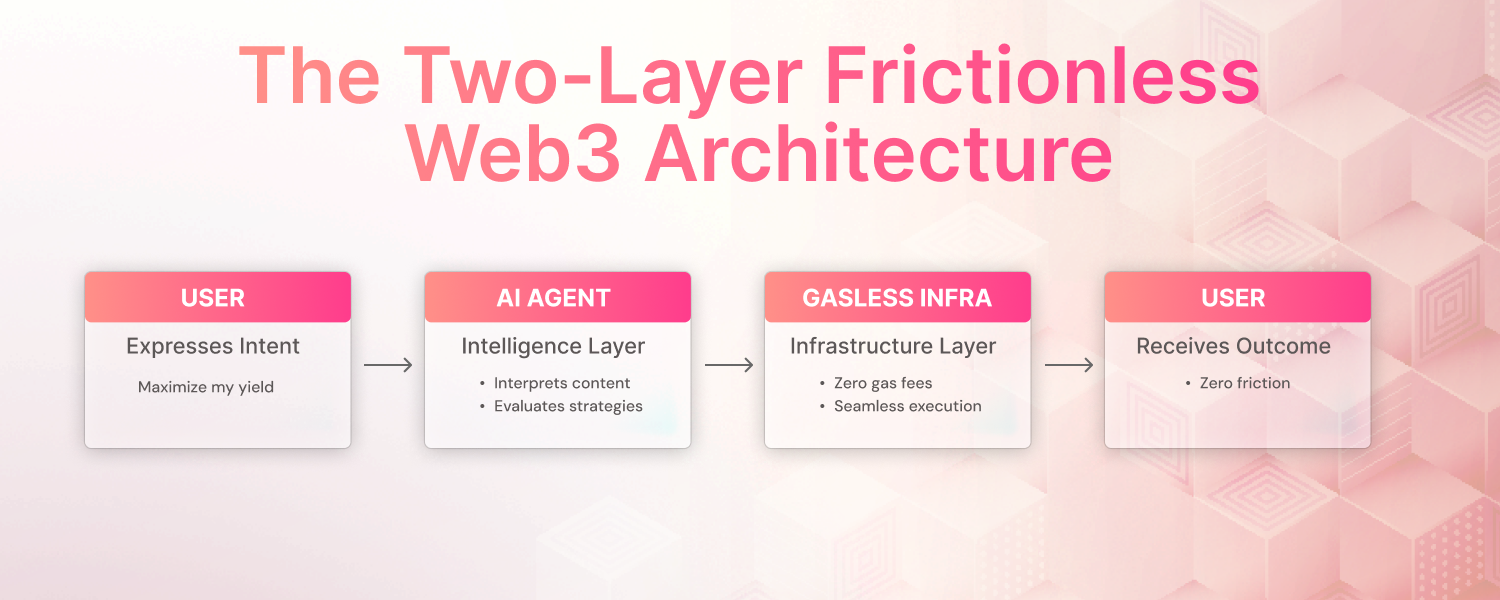
Intent Recognition
An AI agent interprets the user’s request (spoken, typed, or API-triggered), and maps it to a blockchain function. For instance, “Stake my tokens” becomes a structured transaction sequence: token approval → delegation → staking contract call.
Policy and Permission Layers
Before execution, the decentralized AI infrastructure confirms the user’s rules: spending limits, slippage thresholds, timing conditions, etc. Agents act only within the stated cognitive policies, guaranteeing both autonomy and safety.
Smart Relayers and Paymasters
After validation, AI-driven relayers negotiate gasless transactions using account abstraction. These agents scrutinize gas markets, choose optimal bundlers, and sponsor/ batch transactions dynamically, lowering costs and improving throughput.
In Abstraxn’s ecosystem, these components are pre-trained and interoperable. Developers just invoke the appropriate agent type – informational, transactional, or wallet-level, and the rest executes automatically. The outcome is a self-optimizing execution layer that learns from every transaction it completes.
The Future: From Gasless to Thoughtless Execution
Gasless transactions solve the economic problem and the AI agents in blockchain resolve the cognitive problem. Together they create what neither can achieve alone: a truly frictionless Web3.
Account abstraction and decentralized AI infrastructure are complementary architectural layers addressing distinct user barriers. The platforms that adopted gasless infrastructure early gained advantage. The platforms pairing that infrastructure with agentic intelligence are defining tomorrow’s standard.
Data reveals that by 2028, 33% of enterprise software applications will include agentic AI, up from less than 1% in 2024. The platforms that defined Web3’s first era built the infrastructure. The platforms defining the next era are building the intelligence layer atop that infrastructure.
Abstraxn intends to close this gap. Our specialized agent network doesn’t replace your gasless infrastructure – it completes it. The future belongs to platforms that don’t just serve users, but also understand them.