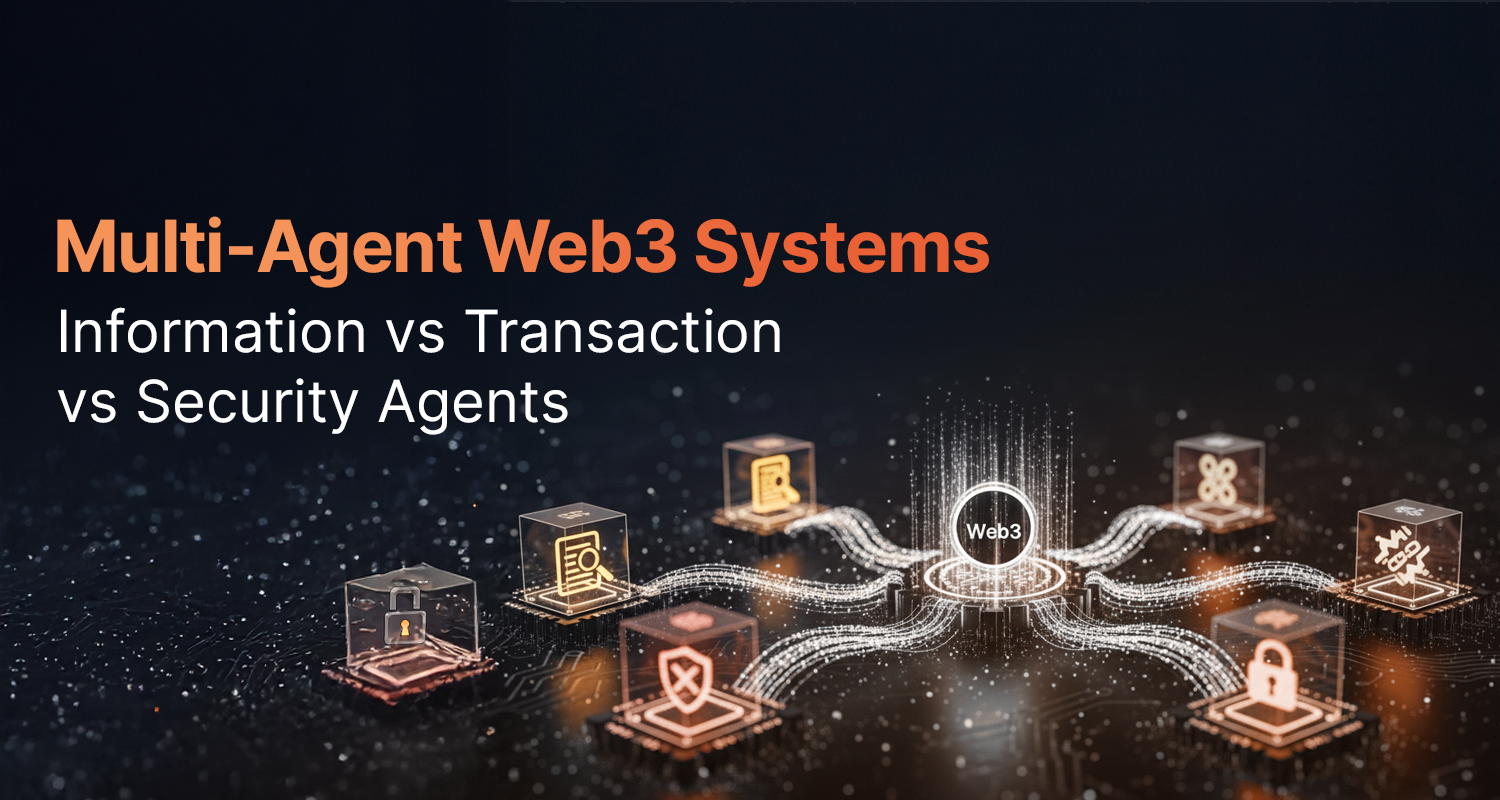
The age of single-purpose automation is slowly evolving to multi-agentic intelligence networks. What began as AI agents in Web3 handling isolated, rule-based tasks is turning into something more profound: a network of decentralized AI networks that don’t just execute, but collaborate, interpret, and learn from one another. The emerging generation of Web3 platforms won’t be defined by speed, but by coordination. Modern platforms offering high-end Web3 experiences are transitioning from monolithic intelligence to distributed cognition, from single execution points to orchestrated networks of specialized agent-based systems.
Multi-AI agents In Web3: Understanding The Specialization Imperative
In decentralized environments, where trust, data, and value are fragmented across protocols, no single agent can own the entire context. This is where agent-based systems in blockchain assume importance – collections of specialized agents that communicate across smart contracts, protocols, and layers, with each performing a unique cognitive role in a distributed ecosystem.
These are like multiple autonomous minds within a shared network. One interprets intent, another executes it, while a third assures it is secure. Together, they form the multi-agent Web3 system – a framework where intelligence becomes composable.
Consider a user requesting “Swap 1000 USDC for ETH, prioritizing gas under 20 gwei, and immediately stake in the optimal yield vault.” A single agent processing this faces competing optimization criteria: response latency Vs calculation accuracy, security verification depth Vs execution speed, yield optimization Vs risk assessment, etc. Each additional constraint creates branching decision trees that add to the processing overhead.
The following two points highlight the need for multi-AI agents in Web3:
Architectural Alignment: There exists a key gap in current Web3 agent deployment – decentralized protocols are governed by distributed consensus, yet user interactions are channelled through centralized intelligence. In this scenario, multi-agentic technology proves highly applicable for developing intelligent distributed systems that manage sensitive data, while blockchain reinforces accountability and trusted interactions within these frameworks.
When a single agent encounters failure, the entire user experience collapses completely. On the other hand, when specialized agents operate in coordinated networks, system degradation becomes gradual and containable.
Context Distribution Challenge: As user interactions grow, maintaining contextual continuity across complex operations becomes crucial. Single agents must simultaneously retain conversational history, track transaction state, check wallet conditions, and preserve protocol-specific parameters. This context accumulation leads to memory constraints and amplifies the chance of errors.
Agent-Based Systems in Blockchain: Specialized Intelligence for Web3
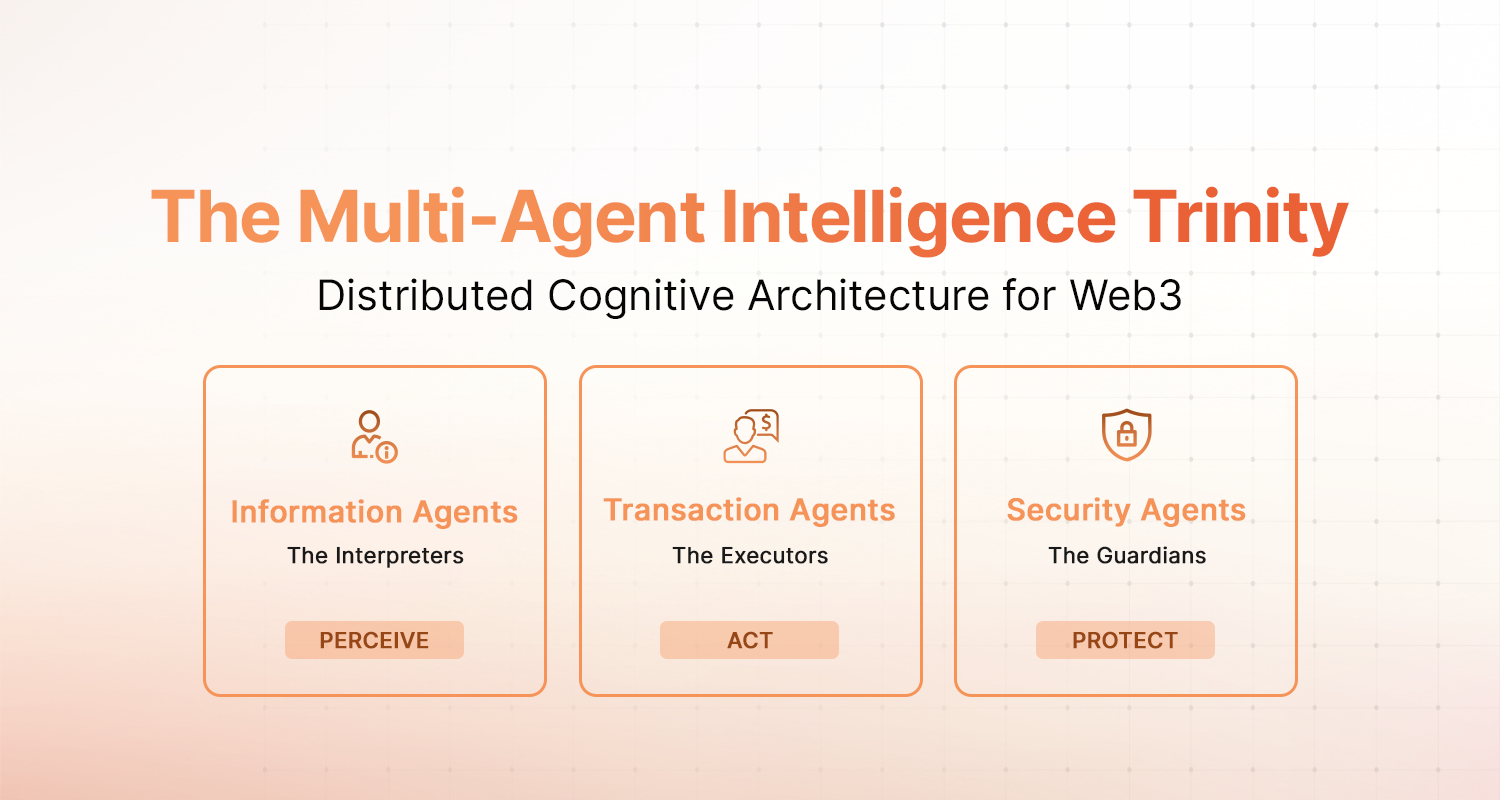
Every multi-agent Web3 system is developed around three cognitive roles: Information Agents, Transaction Agents, and Security Agents. Each exhibiting a distinct dimension of digital intelligence: understanding, execution, and safety. All three types work together to deliver seamless autonomous experiences across decentralized environments.
The Cognitive Interface: Information Agents
Information agents in blockchain serve as knowledge synthesis engines, converting complex protocol mechanics into accessible understanding. Unlike typical chatbots that retrieve pre-programmed responses, these agents deploy natural language processing to interpret context, synthesize multi-source data, and offer focused guidance for diverse user sophistication levels.
For instance, when users query ‘optimal yield strategies for stablecoins’, information agents synthesize real-time APY data across multiple protocols, evaluate impermanent loss risks, scrutinize gas cost implications, and present comparisons aligned with user risk profiles – all within conversational exchanges. Similarly, NFT marketplaces utilize information agents for collection analysis and provenance verification.
The Execution Layer: Transaction Agents
Transaction agents translate user intent into on-chain execution, orchestrating multiple operations that otherwise require dozens of manual interactions. These agents analyze real-time market data, identify opportunities, and execute trades with precision, removing human errors and delays. In DeFi exchanges, transaction agents tackle cross-chain routing complexity. When users request token swaps, these agents evaluate liquidity across multiple DEXs, calculate optimal routing paths considering slippage and gas costs, coordinate bridge operations for cross-chain transactions, and execute atomic swaps maintaining security throughout multi-hop journeys.
The Trust Layer: Security Agents
Security agents form the defense system of decentralized AI networks. These provide continuous threat monitoring and anomaly detection, working as distributed protection systems for Web3 platforms. Access control-related incidents accounted for 81% of the $2.3 billion lost in Web3 security breaches in 2024, calling for the criticality of proactive security intelligence. Wallet providers integrate security agents for transaction validation and phishing detection. AI-driven solutions rely on machine learning and deep learning to enhance blockchain security by analyzing network behaviors and identifying malicious activities.
It is worth noting that distributed context across specialized agents reduces individual cognitive load while improving collective response accuracy. The evolution toward multi-agent systems in Web3 isn’t complexity addition – it’s intelligent distribution.
Real-World Impact: Use Cases of Multi-AI Agents in Web3
As Web3 grows more complex, distributed cognition appears to be the only scalable path forward for intelligence, autonomy, and decentralization to coexist. Multi-agentic architectures are being explored for DeFi optimization, DAO governance, autonomous economic coordination, and other verticals.
Autonomous Capital Efficiency: Decentralized Finance
In DeFi, information agents keep a tab on liquidity and yield performance, transaction agents rebalance positions across chains, and security agents protect against flash-loan attacks or oracle exploits. Together, these create autonomous liquidity loops, where strategies execute themselves as per real-time market data. With multiple agent-based systems in blockchain, DeFi vaults not only earns yield but also thinks about where to allocate it next.
Provenance as Intelligence: NFTs & Digital Identity
NFT ecosystems are leveraging information agents in blockchain to verify provenance, detect counterfeit collections, and generate dynamic metadata. Alongside, security agents validate creator authenticity and secure ownership transfers. AI-based approaches differentiate genuine digital assets from counterfeit copies by studying detailed data patterns and metadata within each NFT, providing real-time verification and enabling users to confirm authenticity before making transactions. In other words, multi-AI architectures reduce the time needed to purchase or sell NFTs by optimizing procedures.
Governance with Cognitive Foresight: DAOs
In decentralized organizations, decision-making frequently collapses under information overload. With intelligent ecosystems, agents handle that load: analyzing sentiment, surfacing key insights, and simulating proposal outcomes. Transaction agents then automate execution post-vote, while security agents guarantee integrity across votes and treasury actions.
Adaptive Economies: GameFi and Metaverse
Multi-agent coordination powers the next era of digital economies, with transaction agents backing autonomous in-game trading, information agents examining user behavior to balance tokenomics, and security agents thwarting exploitative loops – all without centralized control.Apart from the above-stated use cases, agent-based systems in blockchain find applications in supply chain, enterprise, cross-chain trading, portfolio management, and similar other industries. The pattern across all use cases is unmistakable: decentralized cognition is the new operational standard.
Building the Cognitive Fabric of Web3: With Abstraxn
At Abstraxn, the cognitive future of Web3 is operational. We help Web3 platforms transform from manual interaction to intent-driven coordination. Our decentralized AI network of specialized agents: information, transaction, security, and walletOps agents, etc., works as an extensible intelligence layer that any dApp can embed in minutes.
Abstraxn abstracts the backend complexity, so developers focus on outcomes, not orchestration.
Multi-AI agents in Web3 mark the beginning of agentic economies – ecosystems that understand, execute, and secure themselves. They blur the line between infrastructure and intelligence, creating networks that move assets as well as coordinate value. The key intelligent architecture covers information agents as the analysts, transaction agents as the executors, and security agents as the guardians. Together, they form a cognitive architecture that transforms Web3 from reactive automation into proactive coordination. Platforms that integrate these agents early are effectively embedding intelligence into the DNA of their value chains, changing static infrastructure into living systems of coordination.