Most Web3 products today are functionally complete but structurally fragile.
They move assets, sign transactions, and respond to user input reliably. But beneath that surface, execution logic is scattered across wallets, relayers, approval prompts, backend scripts, and monitoring services. Each layer behaves correctly in isolation. Together, they form a system where authority is implicit, accountability is reconstructed after the fact, and automation scales faster than trust.
This is the environment Abstraxn is designed for.
Integration, in this context, is not about wiring another SDK into an existing stack. It is about introducing a missing execution layer, one that interprets intent, governs autonomy, and preserves human oversight even as systems begin to act on their own.
The reason this can be done in minutes is not because the system is simple. It is because the architecture is opinionated.
Why “30 Minutes” Is an Architectural Claim
When platforms promise rapid integration, they usually mean fewer lines of code. Abstraxn’s claim is different. The reduction is not in code volume, but in decision surface.
Traditional Web3 stacks require developers to repeatedly answer the same questions:
Who is allowed to execute this action? Under what conditions? With which constraints? And how do we prove this later?
These questions appear at every layer: wallet permissions, backend services, gas sponsorship logic, monitoring dashboards. Over time, the answers diverge.
Abstraxn collapses these questions into a single execution model. Integration becomes the act of declaring authority once, instead of encoding it repeatedly.
That is why the setup window is short. The system is not just learning what to do, but also what it is allowed to do.
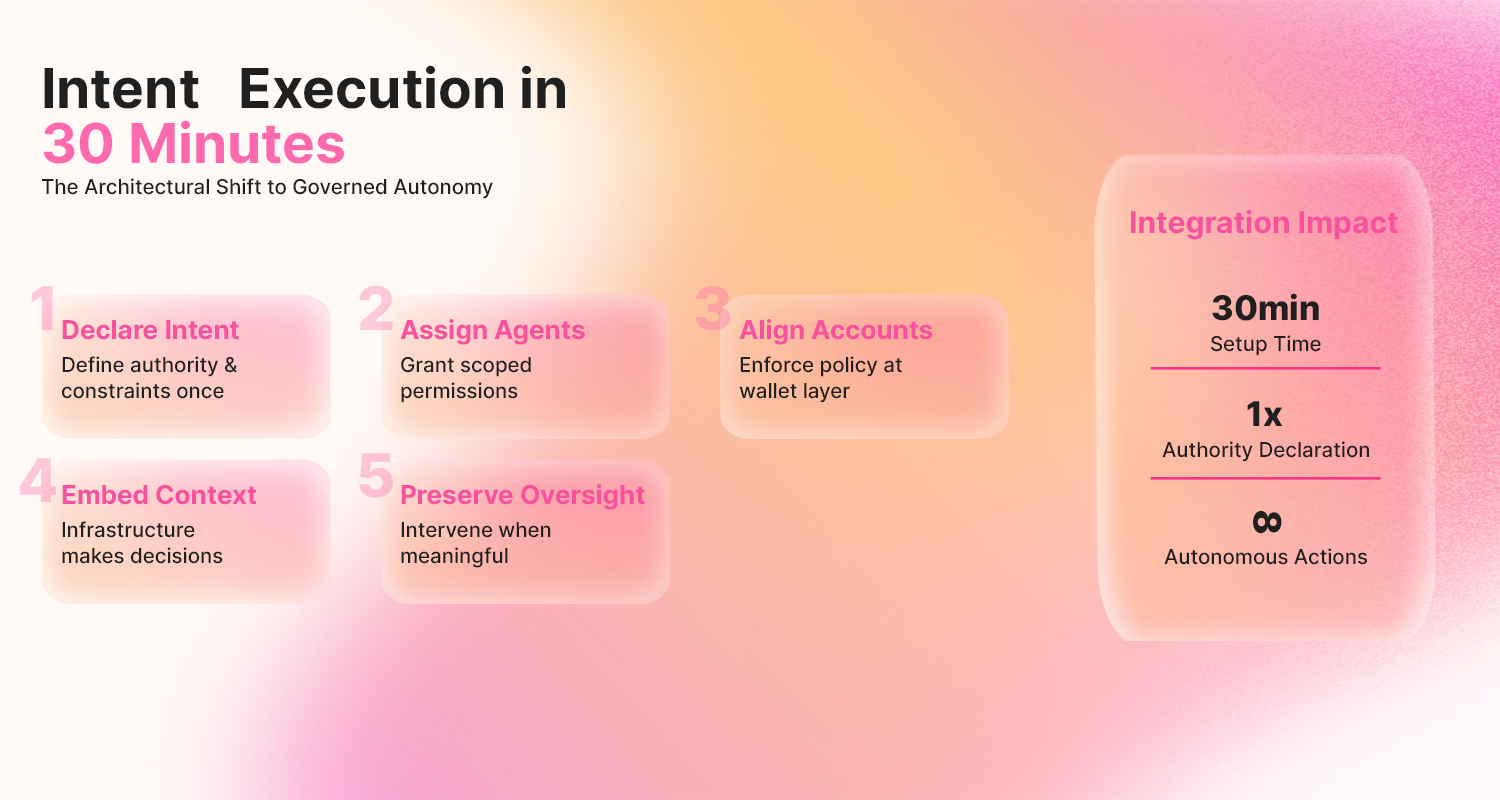
Step One: Reframing Execution Around Intent
The first meaningful shift during integration is conceptual.
Most applications treat user actions as discrete triggers. A button click leads to a function call, which leads to a transaction. Intent exists only implicitly, inferred from UI context.
Abstraxn requires intent to be explicit.
When initializing the SDK, developers define intent parameters that describe why an action should occur, not merely how. These parameters act as guardrails. They specify acceptable outcomes, limits, and dependencies.
This changes execution in three ways:
- Logic becomes declarative
Instead of scripting steps, developers describe conditions and outcomes. Execution adapts within those bounds. - Failure becomes explainable
When an action is rejected, the reason is not “transaction reverted” but “intent boundary violated.” - Users retain authorship
Even when agents act autonomously, intent traces back to a human decision.
The SDK’s role here is not orchestration. It is an interpretation translating human intent into machine-executable constraints.
Step Two: Introducing Agents as Governed Executors
Autonomous agents are often discussed as if autonomy itself is the goal. In practice, autonomy without governance increases operational risk.
Abstraxn’s agents do not intend to replace decision-makers. They are designed to operate within delegated authority.
During integration, developers assign agents narrowly defined responsibilities. These may include monitoring conditions, batching operations, executing transactions, or managing retries. What matters is the boundary.
Each agent inherits:
- A scope of allowed actions
- Temporal limits on execution
- Value thresholds
- A verifiable delegation chain
Agents cannot act outside these constraints. They do not possess credentials. They possess permissions. This distinction is subtle but critical. Credentials imply ownership. Permissions imply accountability.
As a result, autonomous behavior does not dilute responsibility. It focuses on it.
Step Three: Aligning Smart Accounts with Agentic Logic
Once agents are defined, integration extends into the account layer.
Abstraxn uses smart accounts not merely as programmable wallets, but as policy enforcement points. These accounts are aware of intent, delegation, and execution context.
Instead of asking, “Is this signature valid?” the system asks: “Does this action align with declared authority?”
This enables several structural changes:
- Session-based permissions replace perpetual approvals
- Multi-step flows collapse into single governed actions
- Revocation becomes immediate and verifiable
From an integration perspective, developers do not rewrite contract logic. They expose execution hooks that the smart account can evaluate against agent permissions and intent boundaries.
The result is a wallet layer that enforces system logic, along with cryptographic validity.
Step Four: Embedding Intelligence into Execution Infrastructure
Execution does not stop at authorization. It continues through bundlers, paymasters, and relayers. Traditionally, these components operate on static rules: sponsor this address, batch these transactions, submit under these conditions, etc.
Abstraxn’s infrastructure layer behaves differently.
Here, execution components receive context, not just requests. They are aware of:
- Who authorized the action
- Which agent initiated it
- What constraints apply
- How this behavior compares to historical patterns
This allows infrastructure to make decisions rather than follow instructions.
For example, gas sponsorship becomes conditional. A paymaster evaluates whether an operation aligns with declared intent and risk thresholds before subsidizing execution. A bundler prioritizes actions based on urgency and system state, not just arrival time.
Integration at this layer involves configuring decision logic rather than hardcoding rules. Developers describe how decisions should be made, not what the outcome must be.
Step Five: Preserving Human Oversight Without Reintroducing Friction
One of the most common failures in automation systems is the false trade-off between speed and control.
Abstraxn resolves this by separating oversight from interruption.
Humans remain governors of the system. They define intent, approve delegation, and retain the ability to intervene. But they are not required to supervise every execution step.
During integration, developers specify escalation paths:
- Which actions require renewed confirmation
- When step-up authentication is triggered
- How anomalies are surfaced
This ensures that when human input is needed, it is meaningful. The system does not ask for approval out of habit. It asks when thresholds are crossed.
As a result, automation scales without eroding trust.
Why the SDK Does Not Feel Like a Traditional Walkthrough
A conventional SDK walkthrough explains functions, parameters, and return values. Abstraxn’s SDK is better understood as a control surface.
Its abstractions are architectural:
- Intent definitions
- Agent scopes
- Authority chains
- Execution policies
These elements are composed, not called.
This is why experienced teams often find that integration feels shorter than expected. They are not assembling components. They are aligning their system with an execution philosophy that already matches how they think.
What Changes After Integration
The most visible outcome is operational efficiency. Transactions batch more effectively. Gas costs stabilize. Execution latency drops.
But these are secondary effects.
The deeper change is cognitive. Teams stop reasoning about individual transactions and start reasoning about system behavior.
Questions shift from: “Why did this transaction fail?” to “Was this action within bounds?”
From: “Who triggered this?” to “Who authorized this class of behavior?”
From: “How do we automate this safely?” to “How do we calibrate autonomy?”
This is the level at which Abstraxn operates.
Integration as a Commitment, Not a Convenience
Integrating Abstraxn commits the system to a particular stance on autonomy, accountability, and execution.
It assumes that:
- Automation will increase
- Agents will act without immediate supervision
- Trust must be enforced structurally, not socially
The SDK simply makes that commitment executable.
Thirty minutes is enough time to connect the system. Understanding the implications takes longer. That is by design.