Wallet authentication remains one of the most fragile points in Web3 onboarding.Not because wallets are complex, but because they are often handled outside the product experience.
Abstraxn provides Wallet-as-a-Service through a lightweight SDK and centralized dashboard orchestration. Authentication providers are configured once at the infrastructure level and reused securely across all deployment environments.
Browser extensions, gas prompts, and signing requests interrupt user flow before value is delivered. For developers, this creates a tradeoff between security and usability that should not exist at the authentication layer.
Abstraxn approaches this problem from an infrastructure standpoint. Wallet authentication should behave like application authentication. It should be embedded, predictable, and owned by the product.
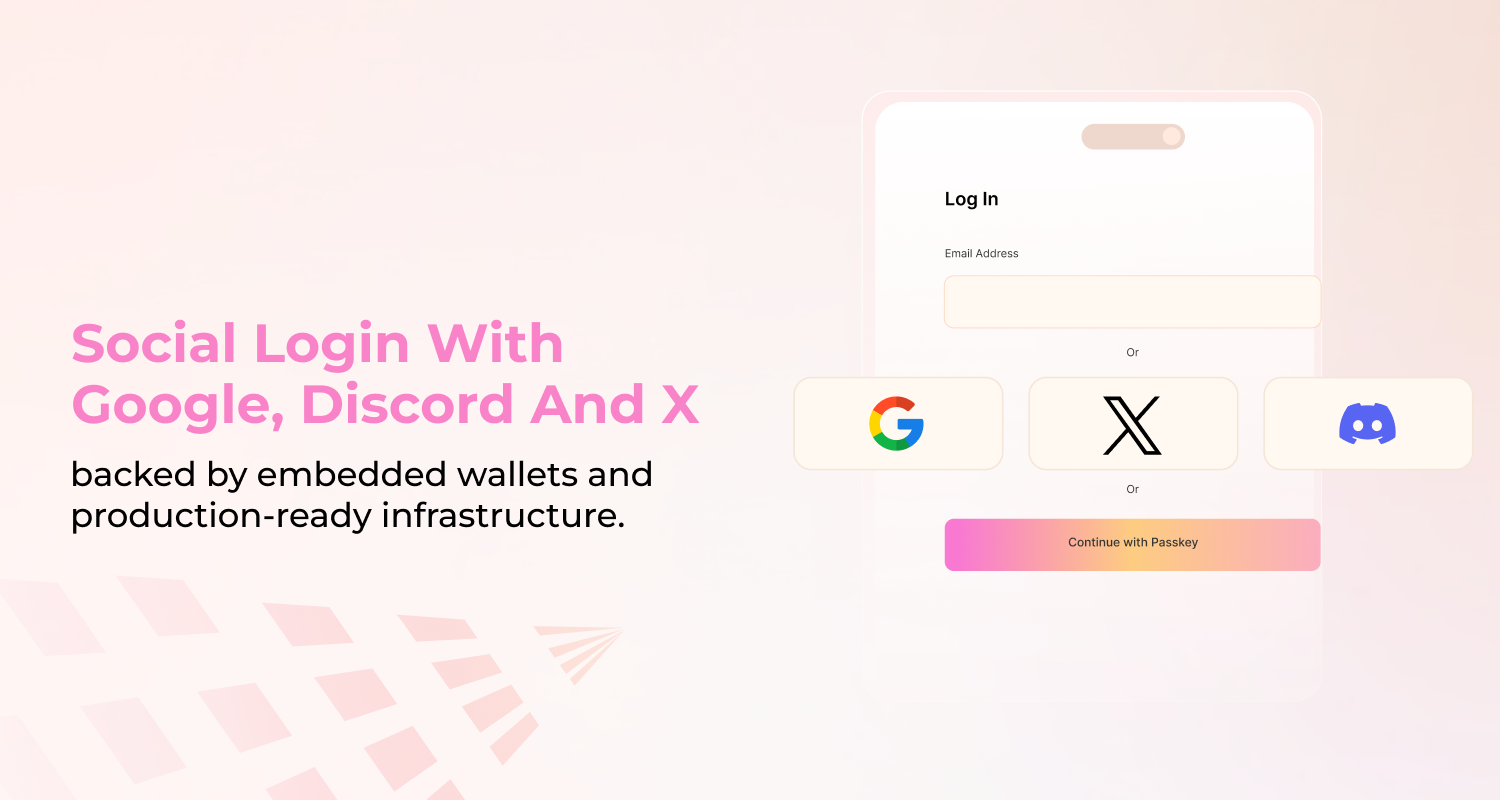
We approach this problem purely from an infrastructure standpoint. Wallet authentication must mirror native application authentication. It must be embedded, predictable, and entirely owned by the product. By implementing social login via Google, Discord, and X through Abstraxn’s Wallet-as-a-Service, developers can provision non-custodial wallets instantly, shifting authentication from a fragmented wallet choice screen into a seamless onboarding primitive.
Wallet Authentication for dApps Is an Onboarding Problem
Authentication determines whether users enter an application or abandon it. In most Web3 products, authentication is delegated to external wallets that were never designed to represent application identity.
This creates three operational issues:
- Wallet prompts interrupt user actions
- Signing flows feel external to the application
- Execution becomes visible before users understand value
Wallet Authentication for dApps needs to solve entry, not ownership. Ownership comes later. Authentication needs to confirm intent, create a wallet context, and allow users to proceed without switching environments.
Abstraxn treats authentication as wallet provisioning. When a user logs in, a wallet is created or retrieved automatically, inside the application flow.
Social Login as a Web3 Authentication Solution
Social login via Google, Discord, and X are not conveniences. They are familiar authentication systems that users already trust for identity verification.
In Web3 onboarding, social login reduces two forms of friction:
- Cognitive friction caused by wallet selection
- Operational friction caused by signing requirements during first interaction
Wallet abstraction authentication allows developers to use familiar login methods while still creating non-custodial wallets under the hood. The user logs in with social login via Google, Discord, and X. The application provisions a wallet automatically. No external wallet setup is required at this stage.
This approach does not replace wallets. It defers wallet management until users are ready to engage deeper.
Seconds for Users, Minutes for Developers
User authentication completes in seconds.
Infrastructure integration completes in minutes.
When developers say “X lines of code,” they often mean the wallet creation call itself. In production systems, integration includes:
- Installing and configuring the SDK
- Creating a project in the dashboard
- Generating and securing API keys
- Configuring authentication providers
- Defining wallet creation behavior
- Enabling optional external wallet support
Abstraxn is designed around this reality. Wallets are provisioned in seconds for users. Developers integrate the system responsibly in minutes.
Good onboarding hides complexity from users, not from developers.
Google, Discord & X Login with Abstraxn
Abstraxn provides Wallet as a Service through an SDK and dashboard-driven configuration. Authentication providers are configured once and reused across environments.
The high-level integration flow is consistent:
- Integrate the Abstraxn SDK into your dApp
- Configure Google, Discord & X login in the Abstraxn dashboard
- Generate API keys and environment credentials
- Define wallet provisioning behavior on successful login
- Enable external wallet support if required
Once configured, wallet creation and authentication are handled programmatically.
From the application’s perspective, authentication returns a user session with an associated wallet. No wallet pop-ups appear. No signing loop is required.
Wallet creation happens automatically on first login. Subsequent logins retrieve the same wallet. This approach allows developers to add social login without compromising wallet ownership or security assumptions.
Wallet Abstraction Authentication in Practice
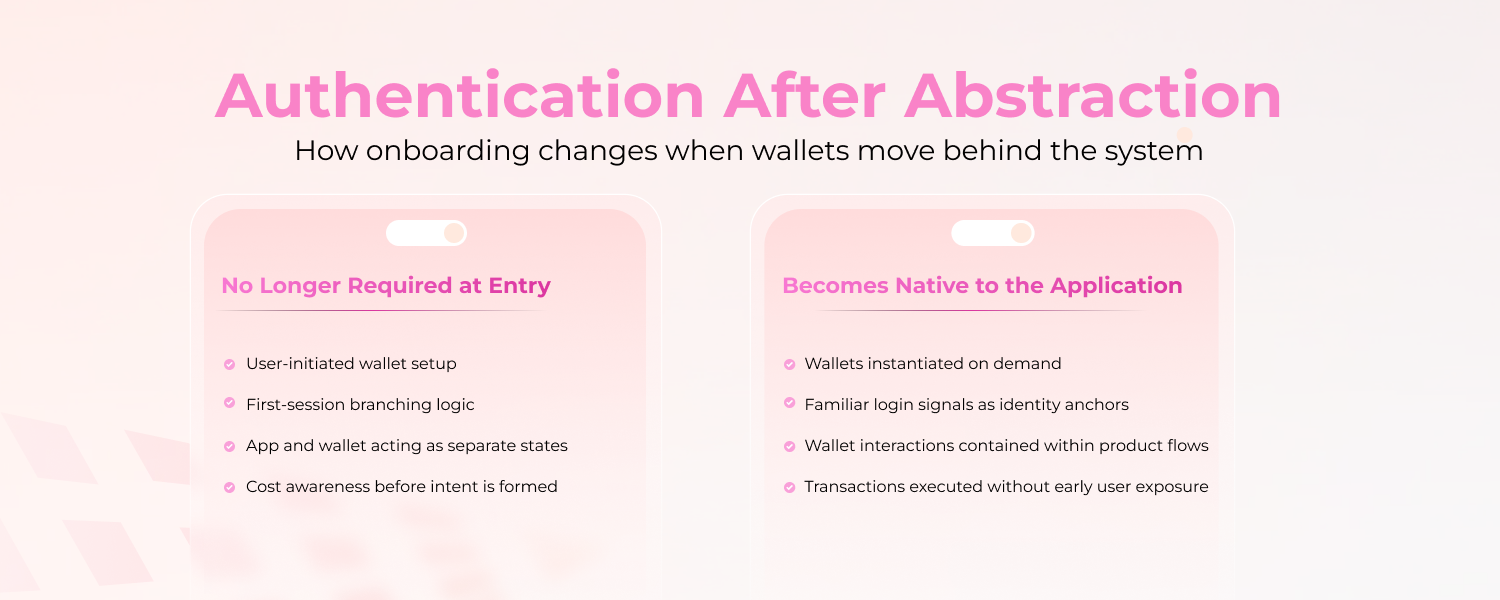
Wallet abstraction authentication shifts responsibility from the user to the infrastructure layer.
What this removes for developers:
- Manual wallet connection flows
- Conditional logic for first-time users
- Generating and securing API keys
- Authentication state split across wallet and app
- Early gas exposure
What it enables:
- One-click wallet creation
- Passkey and social authentication
- In-app wallet flows
- Programmatic transaction execution
The wallet exists, but it does not dominate the experience. Authentication feels native to the application.
Supporting MetaMask Alongside Social Login
Social login does not replace external wallets. Many users will still prefer MetaMask or other browser wallets once they are engaged.
Abstraxn supports external wallet authentication alongside embedded flows. Developers can offer Google, Discord, X and MetaMask as parallel options without fragmenting the user experience.
This flexibility matters in production environments where different user segments expect different entry points.
Wallet Authentication for dApps should accommodate both first-time users and experienced users without changing application logic.
Wallet as a Service as the Onboarding Backbone
Wallet as a Service is not about abstraction for its own sake. It is about ownership of onboarding.
When authentication is externalized, the product loses control over:
- User flow continuity
- Error handling
- UI consistency
- Security assumptions
With Wallet as a Service, developers control:
- When wallets are created
- How authentication is presented
- How transactions are executed
- How users progress through the produc
Abstraxn provides composable wallet systems that integrate into applications rather than sitting beside them.
Security and Reliability by Default
Authentication is a security boundary. Abstraxn treats it as infrastructure, not UX decoration.
Key principles:
- Wallets are non-custodial
- Keys are never exposed to the application
- Authentication providers are isolated from execution logic
- Transaction execution uses production-ready infrastructure
Security is not presented as a feature. It is assumed as a baseline.
Closing Perspective
Wallet Authentication for dApps should feel like application authentication, not wallet negotiation.
Social login via Google, Discord, and X are effective because they are familiar. Wallet abstraction makes them usable in Web3 without compromising ownership or security.
Abstraxn provides Wallet as a Service that allows developers to integrate social login, provision wallets programmatically, and retain full control over the onboarding experience.
Authentication happens once. The product experience continues.