Gas fee remains one of the biggest breakpoints in Web3 onboarding. The account abstraction paymaster model shifts this dynamic, letting applications sponsor gas, accept ERC-20 tokens for fees, or subsidize specific actions. Every sponsored operation became a trust decision, and platforms made those decisions with static rulebooks written months ago.
While developers configured spend caps and sender allowlists, the operations themselves evolved. Gas prices spiked during volatility, draining deposits faster than anticipated. The result wasn’t just inefficient – it was invisible until the damage showed up in monthly burn rates.
This is where ERC-4337’s operational pipeline – bundlers, UserOperations, and the EntryPoint – build the foundation for modern gas policy. When paired with a policy layer capable of evaluating user intent, transaction type, and risk, paymasters is a controllable instrument.
The platforms shipping intelligent sponsorship experiences aren’t asking whether to subsidize gas. They’re asking: which operations deserve sponsorship, and can the decision happen faster than the attack?
Understanding Bundler & Paymaster Architecture in Account Abstraction
Understanding intelligent paymasters requires dismantling the infrastructure they operate within.
- The ERC-4337 Execution Stack
ERC-4337 integrates account abstraction without consensus-layer changes, using UserOperations: transaction-like structures carrying sender, calldata, gas parameters, and signatures. Unlike conventional transactions carried out by Externally Owned Accounts (EOAs), UserOperations express intent. In other words, users state what they want and the infrastructure determines how to execute it. This intent flows through a specialized architecture:
Bundlers aggregate UserOperations from an alternative mempool. Working as EOAs themselves, bundlers package multiple UserOperations into a single transaction submitted to the EntryPoint contract, getting compensation through fees paid by individual operations. Before inclusion, bundlers simulate operations to verify signatures and fee coverage, a critical validation step that thwarts executing operations that can’t compensate for gas.
The EntryPoint serves as one unified validation gateway. This global smart contract receives bundled transactions, verifies UserOperations, and executes them by calling account contracts with specified calldata. During verification, the EntryPoint ascertains whether accounts or paymasters have sufficient deposits to cover maximum potential gas usage.
- Traditional Account Abstraction Paymaster
In a standard stack, paymasters work like sponsorship executors. They manage deposits with the EntryPoint contract, the native currency pools from which gas fees are fetched. When a paymaster is defined in a UserOperation, the EntryPoint confirms that the paymaster has sufficient deposits, then calls the paymaster’s validation function before performing the operation.
The validation happens through validatePaymasterUserOp, a function that determines whether the paymaster will sponsor the operation. Conventional implementations check against predefined policies: Does the sender appear on an allowlist? Does the operation’s estimated cost exceed per-transaction limits? Has the sender exhausted their daily quota?
These are binary decisions made without context – A rule either passes or fails. But the static policies cannot capture the following: Is this the user’s third failed operation today, or their first transaction after demonstrating high lifetime value? Is the gas price surge temporary network congestion, or the beginning of a sustained spike that will drain deposits by this week’s end?
- Limitations Built Into Static Configuration
While the infrastructure exists, deposits fund the sponsorship, and validation functions execute, every UserOperation in this flow represents a resource allocation decision – one made with yesterday’s assumptions about today’s conditions. The gap between policy configuration and operational reality increases with every block.
From Static Policies to Adaptive Intelligence: AI-Driven Web3 Paymaster Solutions
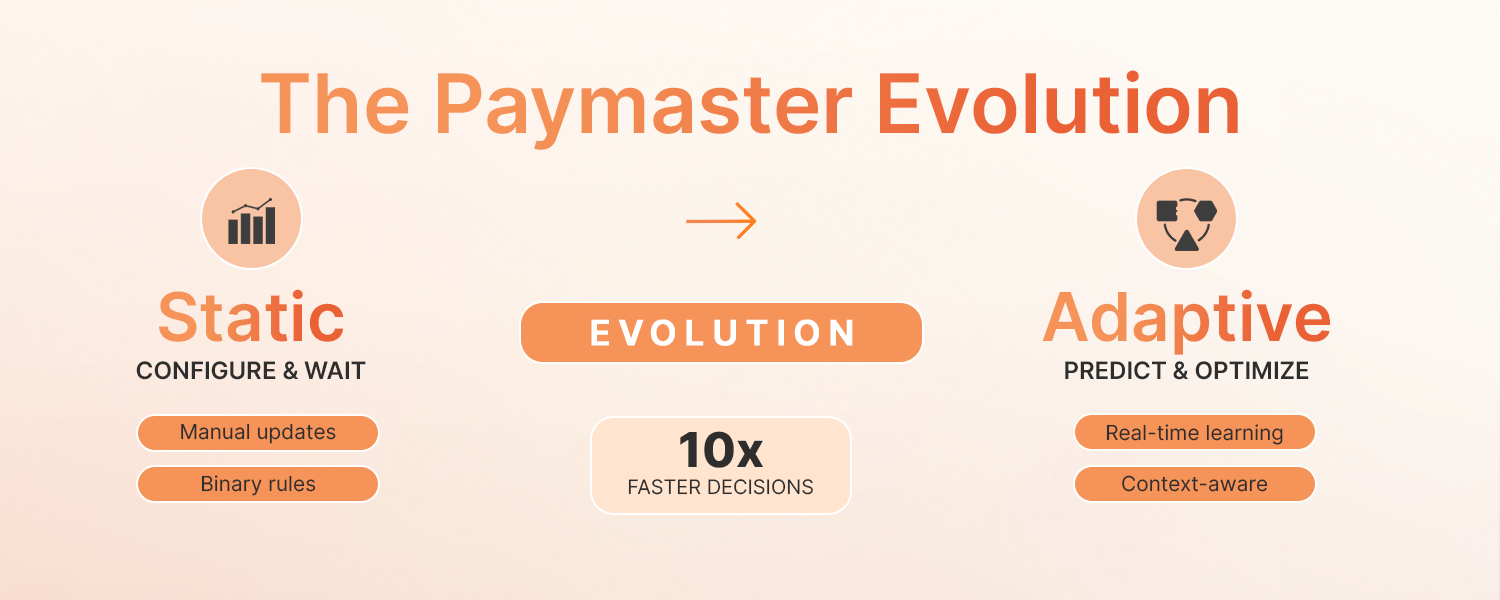
The distance between “configure once” and “respond continuously” is where paymaster solutions diverge into two categories: those that execute rules, and those that apply judgment.
- The Policy Problem: Binary Rules, Continuous Threats
Traditional paymaster implementations operate on the following constraints:
- Maximum spend per UserOperation (e.g., $0.50 ceiling per sponsored operation).
- Daily sender limits (e.g., five operations per wallet address within 24 hours).
- Contract whitelists (only sponsor calls to pre-approved protocol addresses).
- Network throttling (reduce sponsorship during gas price spikes).
These rules work, but not for all scenarios.
The following situations are handled poorly by the static policies:
- A power user completes their fourth high-value operation of the day. Their fifth attempt hits the daily limit and reverts to manual payment, inducing friction at the moment of peak engagement. Meanwhile, an attacker distributing operations across fresh wallet addresses stays beneath per-sender thresholds, systematically draining deposits across hundreds of accounts.
- Gas prices rise 300% during unexpected network congestion. The paymaster continues sponsoring operations at the new rate until someone manually intervenes hours later or until deposits approach depletion and emergency throttling triggers. By then, the budget allocated for weekly sponsorship evaporated in six hours.
Intelligence-Based Sponsorship: Context Over Configuration
Adaptive paymasters evaluate operations through pattern recognition rather than policy matching. Instead of asking “Does this operation violate a rule?”, they assess: “Does this operation’s behavioral signature align with value creation or resource exploitation?”
This assessment monitors multiple signals:
- Historical behavior patterns: How does this sender’s operation frequency, contract interactions, and value transferred compare to established user cohorts?
- Network context awareness: Are current gas prices within normal ranges, or does the market volatility suggest delaying non-critical sponsorship?
- Operation intent classification: Does the calldata indicate a high-conversion operation (completing a swap) versus speculative interaction (querying protocol state)?
- Cross-operation correlation: Is this UserOperation part of a legitimate multi-step workflow, or does it lack connection to prior user activity?
Paymaster Risk Management: The Intelligent Defense Layer
Paymaster risk management in account abstraction environments faces a paradox: the mechanisms designed to prevent attacks become attack vectors themselves when wielded by adversaries who understand the system better than the platforms deploying it.
The Risk Scenarios
Paymasters hold deposits with the EntryPoint contract, ETH balances from which gas costs for sponsored UserOperations are deducted. These deposits face several threat vectors:
- Deposit Drainage occurs when operations consume sponsored gas without creating user value. For instance, a user upgrades their smart account contract to remove nonce validation, then replays a previously-used paymaster signature repeatedly, draining deposits through duplicate sponsorship.
- Sybil Exploitation targets reputation systems. Bundlers maintain reputation tracking for paymasters, throttling or banning those responsible for submitting invalid UserOperations that fail validation after being accepted into bundles.
- Gas Price Manipulation represents indirect drainage – network congestion raises costs, and paymasters continuing to sponsor at higher rates burn deposits faster than budgeted.
From Static Defense to Predictive Intelligence
Typical paymaster risk management applies constraints like per-sender spend limits, per-operation caps, contract whitelists, and time-based throttling. EntryPoint-level protections involve validation gas limits and partial refund penalties – operations consuming less than maximum permitted gas receive only 90% refunds. These defenses assume attacks look recognizably different from legitimate operations. Sophisticated attackers devise operations that pass every static check.
Intelligent paymaster risk management shifts detection earlier – from post-execution analysis to pre-validation assessment.
- Predictive fraud detection:
Assess behavioral signatures against known attack patterns prior to EntryPoint validation.
- Anomaly detection:
Flag UserOperations with unusual gas limits, unexpected contract targets, or unrecognized calldata patterns.
- Dynamic throttling:
Tighten sponsorship criteria during elevated attack activity, and expand during verified legitimate usage.
- Circuit breakers:
Pause sponsorship within seconds when deposit drainage accelerates or coordinated attack signatures emerge.
- The strategic shift:
Risk management turns into resource optimization.
Account Abstraction Paymaster – Sponsorship Strategies
Sponsorship isn’t just about avoiding fraud, it’s assuring that sponsored gas creates more user value than it costs. Agents measure that equation operation by operation. The evolution of Web3 paymaster solutions follows from universal subsidization to intelligent allocation.
Tiered sponsorship segments users by value or behaviour. New users get full subsidization during onboarding; established users transition to partial or no sponsorship. There is better cost control, but the arbitrary thresholds create friction at transition points.
Conditional sponsorship triggers based on specific actions. Complete a swap? – Sponsored. Query protocol state? – Pay your own gas. This aligns costs with value-creating operations, but requires manual policy configuration for every supported interaction.
Intelligent sponsorship assesses each operation individually. No predefined tiers or conditions – agents assess whether the operation’s expected value justifies its sponsorship cost in real-time. This maximises efficiency and minimises friction for high-value users.
Intelligent sponsorship entails new metrics beyond ‘total gas spent’. This includes cost per activated user (CPAU), sponsorship efficiency ratio, conversion lift attribution, etc. While the platforms operating on static policies can’t calculate these metrics because of lack of per-operation granularity, agent-powered paymasters generate this data automatically.
The Path Ahead
The future of paymaster agents is structured coverage, governed by policies that improve with the application’s needs and restrained by risk boundaries that protect capital. With a strong policy layer and predictable sponsorship logic, paymasters can become a competitive advantage. The infrastructure for account abstraction paymaster is predicted to evolve along the following lines:
- Cross-chain coordination will emerge as protocols span multiple networks.
- Paymasters that understand user intent across chains – sponsoring bridging operations that complete journeys started elsewhere, will outperform single-chain solutions.
- Intent-based pricing models might replace flat subsidization. Instead of sponsoring gas costs, paymasters will price sponsorship against expected user lifetime value – investing more in high-potential users and less in speculative interactions.
- Protocols will select from multiple sponsorship providers based on cost efficiency, risk management sophistication, and integration simplicity. The Web3 paymaster solutions that survive will be those demonstrating measurable ROI.
Deeper agentic integration connects paymaster decisions to broader execution frameworks. Sponsorship turns out to be a component of end-to-end intent fulfillment – agents that handle wallet operations, transaction routing, and gas management as unified workflows.
Closing Word
Paymasters have evolved from simple subsidy mechanisms to strategic differentiators. If platforms keep treating gas sponsorship as a cost center, it will continue burning budgets on operations they can’t evaluate. On the other hand, the platforms deploying intelligent paymaster agents will convert that same spend into measurable competitive advantage.
The bundler & paymaster architecture exists. The account abstraction infrastructure is live. But what separates leaders is the cognitive layer operating above it – agents that don’t just execute sponsorship policies, but continuously optimize them. Paymaster Agent of Abstraxn integrates directly into your existing stack, transforming static sponsorship rules into adaptive intelligence without requiring infrastructure rewrites. Within minutes, your platform shifts from reactive configuration to prescient execution.