
The public story of Web3 generally focuses on wallets, UX, and composable protocols; but beneath that narrative lies a quiet friction point: the execution layer. Your product can have the cleanest UX and the smartest intent parser, but if the machinery that facilitates transactions to the chain is slow or unpredictable, the experience collapses into failure modes – and that is what users remember.
This bottleneck shows up as stalled swaps, partial flows, stranded approvals, and cascading retries – signs that look like “backend bugs” to users but are really architectural mismatches. As Web3 progresses from manual flows to agentic intent streams, this execution layer gains the ability to anticipate, prioritize, and adapt in real time.
The Web3 relayer guidelines and bundler infrastructure that power these experiences weren’t designed for autonomous agents making thousands of context-aware decisions per second. They were built for humans clicking through interfaces.
The strategic pivot is clear: relayers must be redesigned for intent-first, not click-first execution.
From User Actions to Agentic Intents: The Evolving Web3 Relayer Guidelines
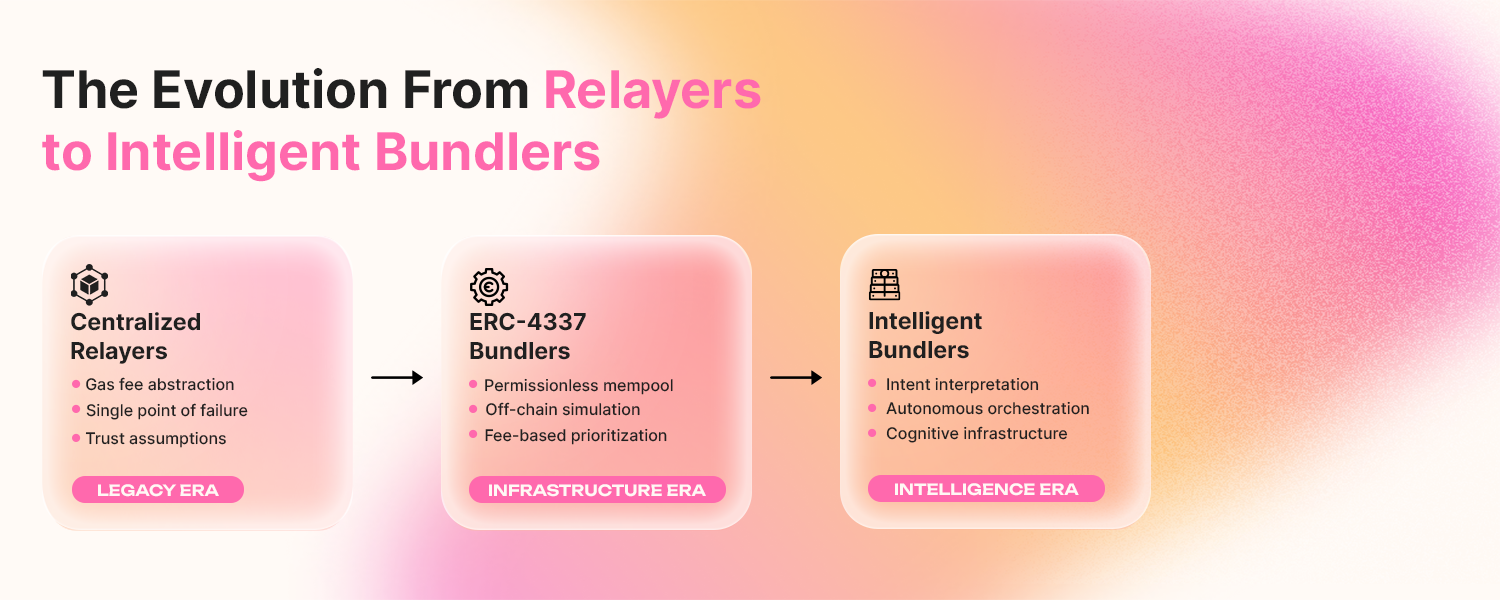
Lately, Web3 has evolved from centralized relayers to intelligent bundlers.
The Relayer Era: Meta-Transactions and Centralized Control
Typical meta-transactions saw relayers as third-party entities that covered gas fees by turning signed messages into valid transactions, allowing gasless experiences for end users. But this model also had inherent limitations. Centralized relayers introduced single points of failure, trust assumptions, and struggled with scalability during network congestion.
Running effective relayer networks involved handling transaction ordering, security, dropped transactions during high gas periods, and managing accurate nonce tracking systems – complexity that often outweighs the benefits. Simply put, early Web3 relayer guidelines focused more on uptime and gas subsidies than intelligent orchestration.
The Bundler Breakthrough: ERC-4337’s Decentralized Architecture
ERC-4337 bundlers collect UserOperations, simulate them for validity, and package them into calls to the EntryPoint contract on-chain – all without any consensus-layer changes. This architectural shift replaced centralized relayers with a permissionless mempool where bundlers compete based on efficiency, reliability, and fee optimization.
While relayers were transaction forwarders, bundlers choose which UserOperations to include based on fee-prioritization logic similar to block builders, paying gas fees upfront and getting compensated through individual UserOperation executions. Modern blockchain bundler optimization focuses on validation depth, economic sustainability, and execution guarantees – concerns that simple relayer architectures couldn’t address.
The shift from manual to autonomous interactions demands bundlers that understand intent, not just execute transactions. Intelligent platforms are building the cognitive layer that integrate AI agents. Blockchain bundlers have evolved into sophisticated frameworks for autonomous execution.
Pillars of Blockchain Bundler Optimization
Optimizing bundler architecture for agentic interactions requires revamping every layer of the validation and execution stack. The following pillars highlight the difference between infrastructure that serves AI agents and the infrastructure that constrains them.
- Simulation-First Architecture
Bundlers must simulate UserOperations off-chain before inclusion to ensure operations won’t revert during validation, preventing gas losses as bundlers pay upfront and only get reimbursed if operations succeed. Effective blockchain bundler optimization begins with multi-stage validation.
First operation simulation validates each UserOperation individually, followed by bundle simulation during bundling to ensure operations remain valid, with a third validation of the entire bundle before on-chain submission. This catches state changes between simulation and execution, which is critical when AI agents generate operations based on rapidly evolving on-chain conditions.
This triple-validation approach decreases revert rates for agent-generated operations.
- Intelligent Mempool Management
Bundlers maintain alternative mempools for UserOperations with specialized sanity checks including sender contract existence verification, factory staking validation, and paymaster deposit sufficiency. Advanced ERC-4337 bundlers implement dynamic fee markets that adjust based on mempool depth and predicted congestion.
ERC-7562 defines validation rules including reputation tracking, with bundlers maintaining peer reputation scores and dropping operations from unreliable actors. For agents, this implies operations route through bundlers with proven reliability – reducing latency and improving execution confidence. Intelligent bundlers that understand operation dependencies can batch related UserOperations, assuring complete success or complete reversion.
- Security-by-Design
Before accepting UserOperations, bundlers verify factory staking requirements when initCode accesses global state, and confirms paymasters have sufficient deposits and aren’t presently banned. ERC-4337 bundlers also need to enforce storage access restrictions and opcode limitations.
UserOperations can only access data related to their sender address, preventing multiple UserOperations from accessing the same storage – making it impossible to invalidate large numbers of operations with a single state change. This isolation is critical when AI agents generate operations based on shared protocol state.
- Economic Sustainability
Bundlers pay gas fees for bundle transactions in ETH upfront and get compensated through fees from individual User Operation executions, an economic model central to blockchain bundler optimization. Bundlers choose User Operations based on fee-prioritization logic used by Ethereum block builders, but AI-generated operations introduce new dynamics.
Smart bundler economics adapt to agent behavior patterns. Operations from established agents with high success rates earn priority even at lower fees, while unproven agents pay premium rates until they build a reputation.
- Decentralization Without Fragmentation
ERC-4337 attains account abstraction benefits while preserving decentralization through permissionless mempool and bundler ecosystems. Modern Web3 relayer guidelines focus on decentralization, but ERC-4337 bundlers balance this with practical coordination needs.
Bundlers propagate UserOperations through P2P mempools, with reputation systems tracking peer behavior. For agent networks, this means operations can reach any bundler without vendor lock-in. Production bundlers need to comply with bundler-spec-tests to ensure consistent behavior across implementations. Interoperable infrastructure ensures agents can optimize execution paths without being constrained by bundler availability.
- Agentic-Native Design
While the previous five pillars optimize the existing bundler architecture, this sixth pillar overhauls infrastructure specifically for autonomous agents.
Stateful Session Management: Standard bundlers treat each UserOperation atomically. Agentic workflows require maintaining context across related operations – understanding that operation N+1 depends on the success of operation N. Smart bundlers track agent sessions, letting batch validation for related operations.
Event-Driven Execution: Rather than polling for transaction confirmations, agentic infrastructure pushes state changes to listening agents. This enables agents to react to on-chain events in real-time, thus composing new operations as per execution outcomes.
Agent-First APIs: The most forward-looking ERC-4337 bundlers expose APIs designed for agent consumption – structured error responses that agents can parse, confidence scores for simulation results, and execution guarantees that allow autonomous retry logic.
Infrastructure that speaks the language of agents (intent, confidence, atomicity) rather than just transactions (gas, nonce, signature) facilitate fully autonomous experiences.
Implementation Pathway
The shift from conventional relayer patterns to agentic-native bundler architecture doesn’t require a complete infrastructure overhaul – it just requires strategic recalibration of where intelligence sits in your stack.
- Assess Your Infrastructure Foundation
Most platforms face a binary choice: operate bundlers internally or integrate with specialized service providers. The decision depends less on technical capability and more on strategic focus.
Self-Hosted Bundlers extend maximum control over validation logic, fee optimization strategies, and custom workflows. This approach makes sense for platforms with:
- High transaction volumes justifying dedicated infrastructure.
- Specific compliance or regulatory requirements.
- Custom account abstraction implementations beyond standard ERC-4337 bundlers.
- Engineering resources to manage bundler infrastructure and monitoring.
Bundler-as-a-Service providers abstract infrastructure complexity, enabling focus on user experience rather than blockchain bundler optimization. This path suits platforms prioritizing:
- Rapid deployment and iteration cycles.
- Multi-chain support without managing separate bundler networks.
- Proven reliability and uptime guarantees.
- Reduced operational overhead.
Early-stage platforms benefit from managed services that accelerate learning. Mature platforms with clear architectural requirements often transition to hybrid models – managed bundlers for standard operations and custom infrastructure for differentiated features.
Most platforms face a binary choice: operate bundlers internally or integrate with specialized service providers. The decision depends less on technical capability and more on strategic focus. Self-Hosted Bundlers extend maximum control over validation logic, fee optimization strategies, and custom workflows. This approach makes sense for platforms with: Bundler-as-a-Service providers abstract infrastructure complexity, enabling focus on user experience rather than blockchain bundler optimization. This path suits platforms prioritizing:
Early-stage platforms benefit from managed services that accelerate learning. Mature platforms with clear architectural requirements often transition to hybrid models – managed bundlers for standard operations and custom infrastructure for differentiated features. Typical bundler metrics (transactions per second, bundle inclusion rates, etc.) estimate infrastructure health but miss what makes agentic experiences work. For platforms integrating Abstraxn’s agents, focus on: Agent-generated operations should validate successfully >99% of the time. Lower rates indicate either inadequate simulation or bundler incompatibility with agent workflow patterns. When agents generate sequences (approve → swap → stake), calculate how often entire sequences succeed versus partial execution. Broken atomicity destroys user trust in autonomous workflows. Compare gas costs for agent-orchestrated operations versus manual equivalents. Smart bundler selection and operation batching should reduce costs 15-30% even before platform subsidies. From user expressing intent to on-chain confirmation – measure this end-to-end. Agentic experiences feel real when latency stays below 10 seconds for simple operations, 30 seconds for complex workflows. These metrics reveal whether your bundler infrastructure allows or constrains intelligent experiences. Bundlers are no longer just transaction processors – they’re evolving into the cognitive infrastructure that makes autonomous Web3 interactions possible. These patterns are already reshaping which platforms users trust with complex operations. The platforms that recognize ERC-4337 bundlers as cognitive infrastructure rather than transaction pipes are already measuring success differently – not just in throughput or latency, but in user retention, transaction confidence, and the elimination of support tickets for complex workflows.The Bottom Line